
A client walkthrough
One business, all three rungs — the-three-rungs made concrete. Watch what stays constant: every line traces back to something a customer actually wrote.
Read this first. Rung 0 below is a real, unprompted run you can open right now. Rungs 1 and 2 are worked illustrations — real copy, built from the same mined reviews, showing what the later steps produce. They are not a delivered engagement. Nobody has yet bought the paid path, and we’d rather say that than dress a mockup up as a case study. When there’s a real one, this page gets replaced.
Rung 0 — Snapshot (free): the diagnosis
Real run. Stonecraft Kitchen & Bath Remodeling, Charlotte NC. We read 50 of their Google reviews and rebuilt their homepage from what was in them, then sent it unprompted.
It found the gap in five seconds: the word “Charlotte” appeared nowhere on their page, and the owner — named in 43 of 48 written reviews — wasn’t on it either. Their customers were hiring Sal; their homepage was selling “Stonecraft.”
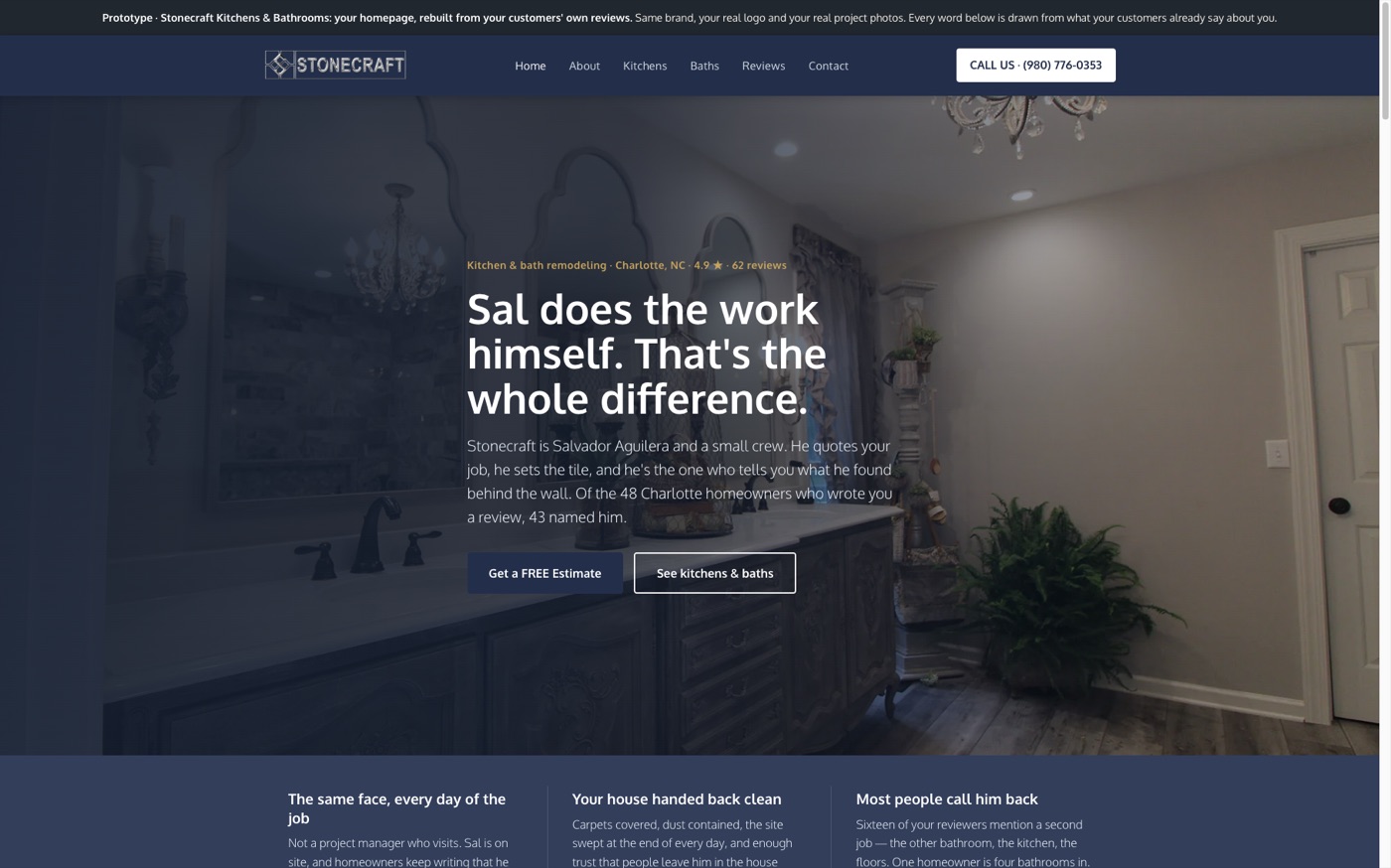
This is the on-ramp, and it costs nothing. It proves the method on one page. → full detail in a-worked-example, or open the live rebuild.
Rung 1 — the Foundation Build ($4,997, once): getting it written down
Worked illustration from here down.
The Snapshot proved one page from the outside. The Build is two conversations that get what’s actually in the owner’s head onto paper — then finishes the job:
- Four documents they own outright — voice, customers, offer, beliefs. Theirs whether or not they continue. These are the source: everything after this gets written from them, and everything already out there gets measured against them.
- That homepage finished and deployed live, not left as a prototype.
- An honest read of where their calls come from — their own accounts, not a vendor’s dashboard. For a remodeler that usually means the Google Business Profile is doing more work than the paid search nobody has audited in two years.
- Their backend wired and filled — contacts, pipeline and email templates set up in the system they already run the business from, with real work already in it.
- The alignment map — every page, profile, bio, email and proposal they already have out there, read against those four documents. For this remodeler: the About page still names a partner who left in 2021, the Google Business Profile description sells the trade they exited, and two directory listings carry a phone number that rings a disconnected line. Ranked by how many people see it. A read, not a rewrite — the list is the deliverable; working down it is the service.
- The drift receipt — their homepage copy from 2019, 2022 and today, against what reviewers were saying each of those years. This is usually the part that lands hardest.
One extra kitchen job pays for this several times over. That’s the whole arithmetic, and it needs no belief in AI to follow.
Rung 2 — the service ($1,497/mo): keeping it true
Worked illustration.
The Build got it right once. Six months on, they’ve added a service, two crew, and forty new reviews — and the page is quietly drifting again. The service is what stops that:
- The alignment map worked down, line by line — the list handed over at the Build, closed out in priority order rather than filed away.
- The four documents kept current as the business actually changes.
- Homepage and owned copy kept true to what customers say now.
- Reviews, replies, listings and the Google Business Profile maintained — the boring, visible things that decide whether someone calls.
- Follow-up sequences kept in their voice.
- A person reads every batch before it reaches them.
The nightly prospecting engine is not in this price. Going out and finding new business is full-lane work, quoted on a call against how much of the business gets handed over. The published $1,497 keeps what they already have true. → rung-2-the-service
And this is where the loop starts paying: a one-line voice note — “stop calling it a remodel, they call it a reno” — is saved once and inherited by every future output. → the-compounding-loop
What this shows
The free redline, the Build and the service are the same system at three depths — not three products. The documents authored at the Build are the same documents every later output reads from. Nothing starts over, and ownership lands at the Build rather than at the top.
Related: a-worked-example · the-three-rungs · rung-1-foundation-build · rung-2-the-service