
A worked example
Here’s the Snapshot run on a real business — Stonecraft Kitchen & Bath Remodeling, a kitchen and bath remodeler in Charlotte, NC, 4.9★ across 62 Google reviews. Nobody asked us to. This is what landed in their inbox.
What their homepage did today
Two things, both checkable in about five seconds.
The word “Charlotte” appeared nowhere on it. Not once, in the whole page source. For a business whose entire market is one metro, that’s the single line that decides whether a homeowner searching “kitchen remodel Charlotte” ever sees them.
And the AI couldn’t find them. We asked a leading assistant about Stonecraft in Charlotte — the way homeowners now check before they search. It didn’t know them, and recommended two competitors instead: DiFabion and Signature Kitchen & Bath. That’s not a market problem. That’s a page problem, and it’s costing them jobs they’ll never hear about.
What their customers actually say
We read 50 of their Google reviews. Three findings, ranked by what each one costs them in customers — not by how interesting it is to us:
- Their owner is the product, and his name is nowhere on the page. Salvador Aguilera is named in 43 of the 48 written reviews. People aren’t hiring “Stonecraft,” they’re hiring Sal.
- Their customers reach for a specific word. Eleven reviewers called him a craftsman. Only six said contractor. One wrote: “We met with several large design and remodeling groups in Charlotte and found Stonecraft to be perfect for us… These skilled craftsmen (not just a contractor) appreciated this was our house.” — John Watrous, Google review
- Sixteen reviewers mention a second job. The other bathroom, the kitchen, the floors. One homeowner is four bathrooms in. That repeat rate is the strongest proof they have, and their homepage never mentions it.
None of that was on their homepage. All of it was in their reviews.
What we sent back
Not a mockup — their whole homepage, rebuilt as a live page in their own brand. Their real logo, their real project photos, their section order, their fonts. Only the words changed.
The headline we gave them came straight out of the reviews:
Sal does the work himself. That’s the whole difference.
Stonecraft is Salvador Aguilera and a small crew. He quotes your job, he sets the tile, and he’s the one who tells you what he found behind the wall. Of the 48 Charlotte homeowners who wrote you a review, 43 named him.
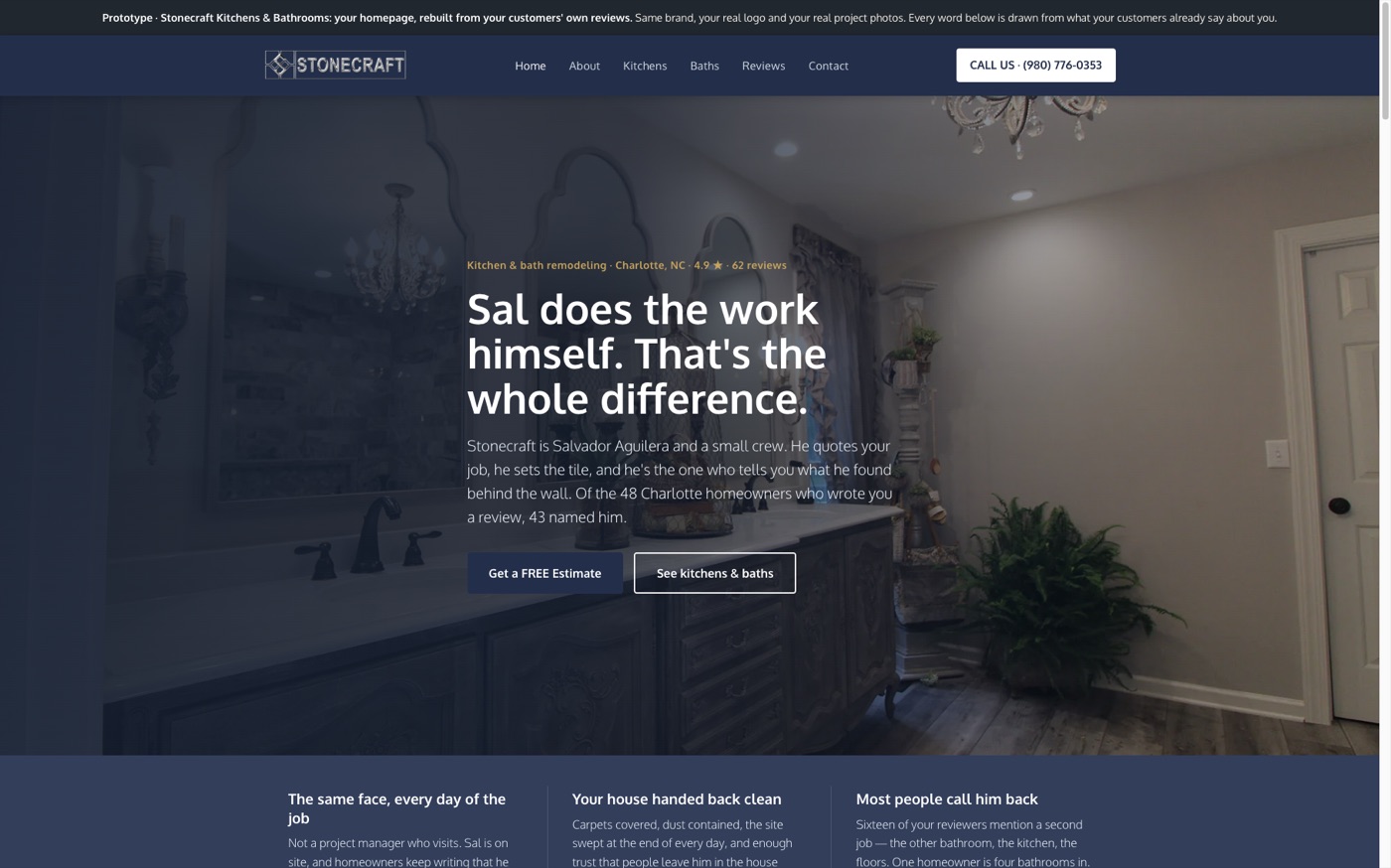
The whole page, top to bottom:
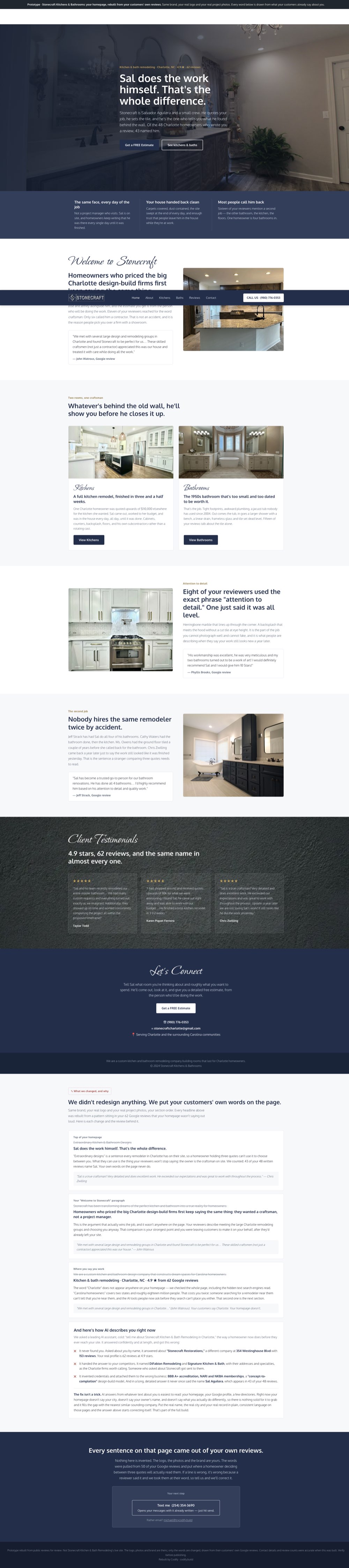
See it live: previews.codify.build/stonecraft-kitchen-bath-remodeling — the real page, scrollable.
It isn’t one lucky run
Same week, same process, a custom-home builder in Asheville. Their reviews kept saying one thing nobody had ever put on the page: clients were still calling them a decade after moving in.

See it live: previews.codify.build/living-stone-design-build
Why this is the whole pitch
Real work, already done, before any conversation starts. We keep their exact branding so there’s nothing to imagine — they open the link and see their own site saying something truer.
And every line is answerable. If a sentence is wrong, it’s wrong because a reviewer said it and we took them at their word — which is a conversation, not an argument.
Honest notes: 50 real Google reviews mined and cited; logo, photos, fonts and colours pulled live from their rendered site; the “Charlotte appears zero times” finding verified against full page source; the AI-search result reproduced before sending. Review counts and contact details were accurate the day it was built. It’s a prototype for review, not their live site.
What happens next
This rebuild is the free rung. To see what a business gets when they carry on to the Foundation Build and the service, read a-client-walkthrough.